
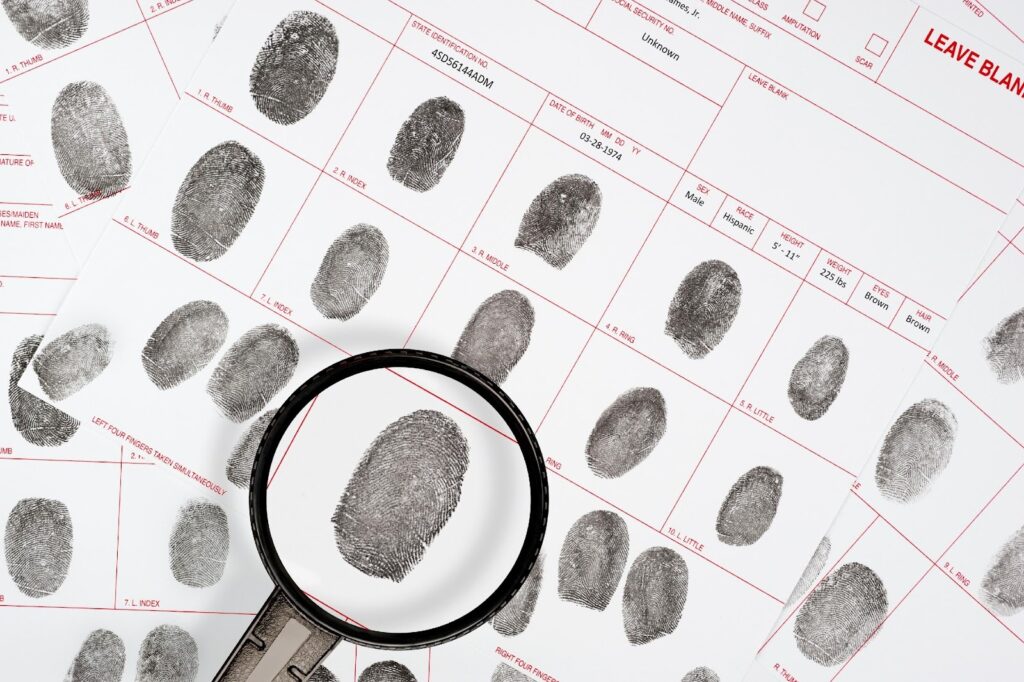
Latent print examination is one of the pillars of 21st-century forensic science that supports identifying persons when information is scarce or incomplete.
As one of the components of biometrics in forensics, latent fingerprint analysis has a foundational approach to linking suspects to crime scenes. This is based on established comparison methods that leverage scientific grounds and support evidence for a wide acceptance in courts.
About Latent Print Examination
Latent prints are fingerprints that a person leaves behind unintentionally, either through touching objects such as a door, a weapon, or an electronic device. These friction ridges are mostly invisible to the human eye and can only be detected and analyzed through specialised identification methods. The examiner first develops the latent print through powder, chemicals, or by using other tools such as an alternate light source. Then, it is photographed and finally digitized to be set up for comparison with other prints.
Modern latent print analysis toolsets provide examiners with a higher level of capability by enhancing the visual quality of the image with precision. An experienced examiner can increase contrast, change light and saturation, and reduce the background without harming the original information. This phase is essential since, compared to tenprint cards, which are the flat impressions of all ten fingers, latent prints are often partial, smudged, altered, or fragmented.
Visual Comparison (and Evaluation)
Once enhanced, examiners use comparison tools to visually compare the latent print with another print that can be from a database or a known print. The comparison presents it side by side, and focus areas and minutiae can be examined properly. Although the tenprint system may help to reduce candidate numbers, the examiner needs to make the final decision based on his experience, training, visual information, international guidelines, and legal authority.
The Importance of High Level Biometric Analysis
High-level biometric analysis helps to achieve competent forensics, which leads to a more consistent, accountable approach integrating human expertise and the automated workflow. The division of labor allows the human effort to focus on timely and effective examination, which is especially logical in a high-volume structure. The automation allows a high load of different types of data to be tracked, integrated, and provides easy discovery of potential answers, which supports timely decision facilitation. Supporting expert task assignment with mathematical and statistical models also empowers the examiner by providing insight into comparison and a higher accuracy rate. And finally, a stronger evidentiary support can be an advantage for a further report or even a recommendation built on the analytic evidence. In the age of more and more intricate crime scenarios, high-level biometric analysis plays a crucial role in producing a reliable and just outcome