

Good software doesn’t happen by accident. Behind every stable release is a structured software testing process that catches defects early, validates behavior, and keeps quality consistent across releases. Tools like aqua cloud help teams manage this end-to-end, while getting time estimation in testing right ensures the process fits the delivery schedule.
What is the Software Testing Process?
The software testing process is a structured sequence of activities that verifies a product works as intended. It spans planning, design, execution, and closure — covering the full development lifecycle, not just the final stages before release. The goal covers both bug detection and cost reduction, stakeholder confidence, and faster delivery. The STLC (Software Testing Life Cycle) provides the framework that makes this possible, running in parallel with the SDLC. By the time execution begins, the team already has clear objectives, documented test cases, a configured environment, and defined exit criteria.
Main Stages of the Software Testing Process
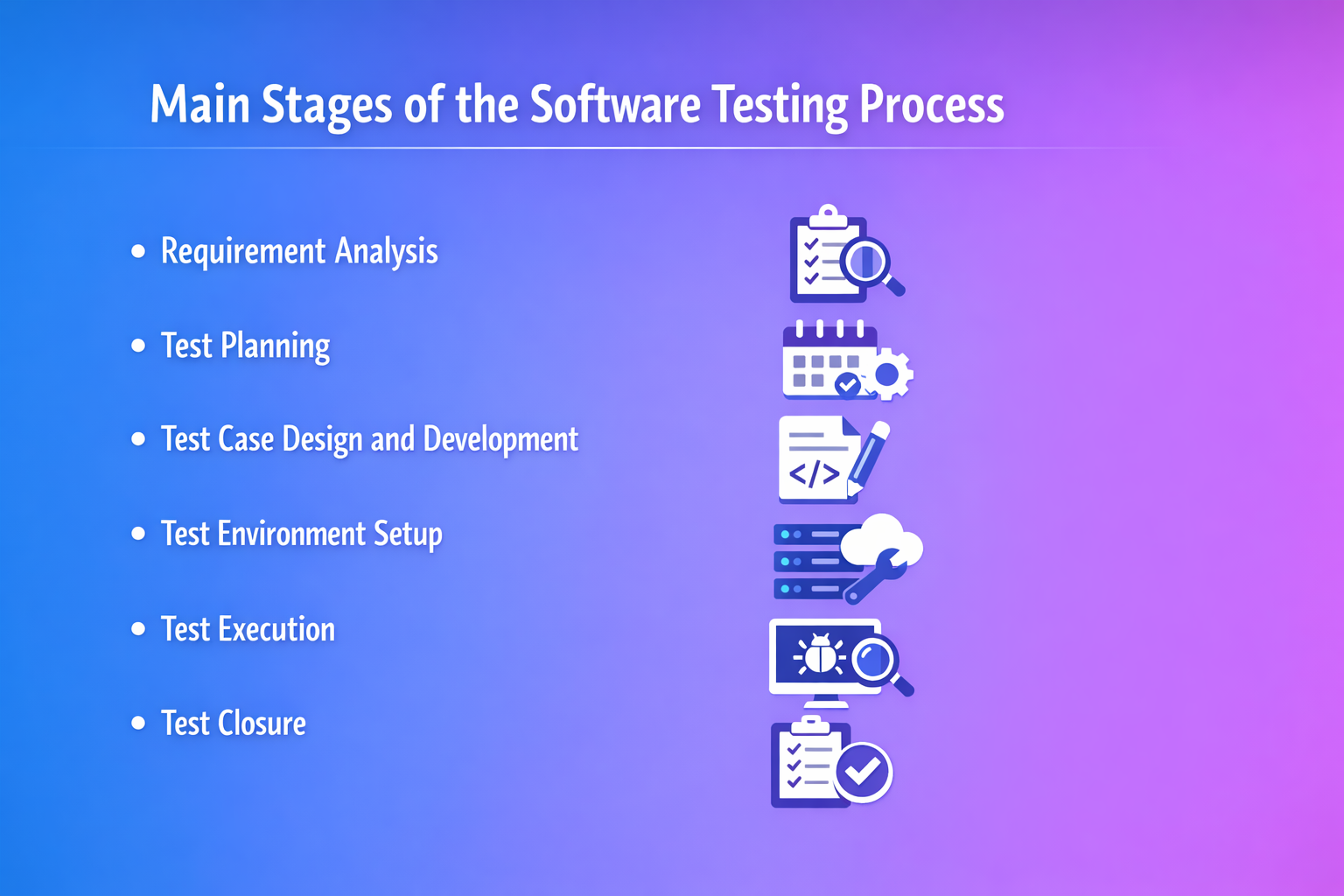
Each stage of the software testing process builds on the previous one. Skipping or compressing any phase creates gaps that typically surface as production defects.
1. Requirement Analysis
The QA testing process starts before any test is written. In this phase, the team studies business requirements, functional specifications, and user stories to understand what the system must do. The goal is to identify ambiguities and flag untestable requirements early.
A tester involved at this stage catches misunderstandings when fixing them costs hours. The key output is a requirements traceability matrix linking every feature to the tests that will verify it.
Output: Requirements traceability matrix, list of testable and untestable requirements, and identified ambiguities.
2. Test Planning
With requirements understood, the team defines the scope, types of tests, tools, environments, and timeline. A solid test plan documents entry and exit criteria, risk assessments, and the overall testing strategy.
Decisions made here shape every subsequent stage of the software testing process. They also set clear expectations for both the QA team and project stakeholders.
Output: Test plan document covering scope, schedule, resources, entry and exit criteria, and risk assessment.
3. Test Case Design and Development
This phase transforms requirements and risk assessments into concrete, executable test scenarios. Each test case specifies preconditions, input data, steps, and expected outcomes. Good test cases are clear, reusable, and granular enough to isolate failures.
Modern test management platforms let teams organize cases into structured suites, assign ownership, and link them directly to requirements for full traceability.
Output: Test cases, test scripts, test data sets, and automated test code where applicable.
4. Test Environment Setup
Well-designed test cases produce misleading results when the environment doesn’t reflect real-world conditions. This phase covers configuring hardware, software, network settings, databases, and third-party integrations.
Environment issues found here would otherwise surface only in production. A stable, documented setup is a prerequisite for consistent results across the entire QA testing process.
Output: Configured and verified test environment ready for execution, with documented setup specifications.
5. Test Execution
Testers run prepared test cases against the build, log results, and document deviations from expected behavior. Defects are recorded, prioritized, and assigned for resolution.
Execution is iterative. As fixes are applied, regression testing confirms no new issues have been introduced. Automation handles repetitive regression and smoke tests, freeing the team to focus on exploratory and edge-case scenarios.
Output: Test execution logs, defect reports, and a pass/fail status for each test case in the suite.
6. Test Closure
Once exit criteria are met, the team reviews completion metrics, archives test artifacts, and compiles a final quality summary for stakeholders. The retrospective component matters equally: identifying what worked and what to improve feeds directly into the next cycle’s planning.
Output: Test summary report, archived test artifacts, and a documented retrospective with process improvement notes.
Common Challenges in the Testing Process and How to Overcome Them
Every team faces friction in the testing process, regardless of experience level. The most persistent issues follow recognizable patterns, and each has a practical fix.
Unclear or shifting requirements
- Test cases become outdated when business needs change mid-cycle
- Fix: Keep QA, development, and product stakeholders in continuous contact
- Use a test management system that makes updating and re-linking test cases fast and auditable
Insufficient time and resources
- Compressed schedules push testing to the margins
- Fix: Invest in accurate upfront estimation and communicate risk clearly to leadership
- When cuts are unavoidable, apply risk-based prioritization to protect coverage of critical functionality
Environment instability
- Flaky environments produce inconsistent results and erode team confidence
- Fix: Adopt environment-as-code practices and containerization for dedicated QA infrastructure
Inadequate defect tracking
- Bugs logged inconsistently make root cause analysis unreliable
- Fix: Integrate defect tracking directly into the QA workflow for full visibility and accountability
Best Practices for Effective Testing
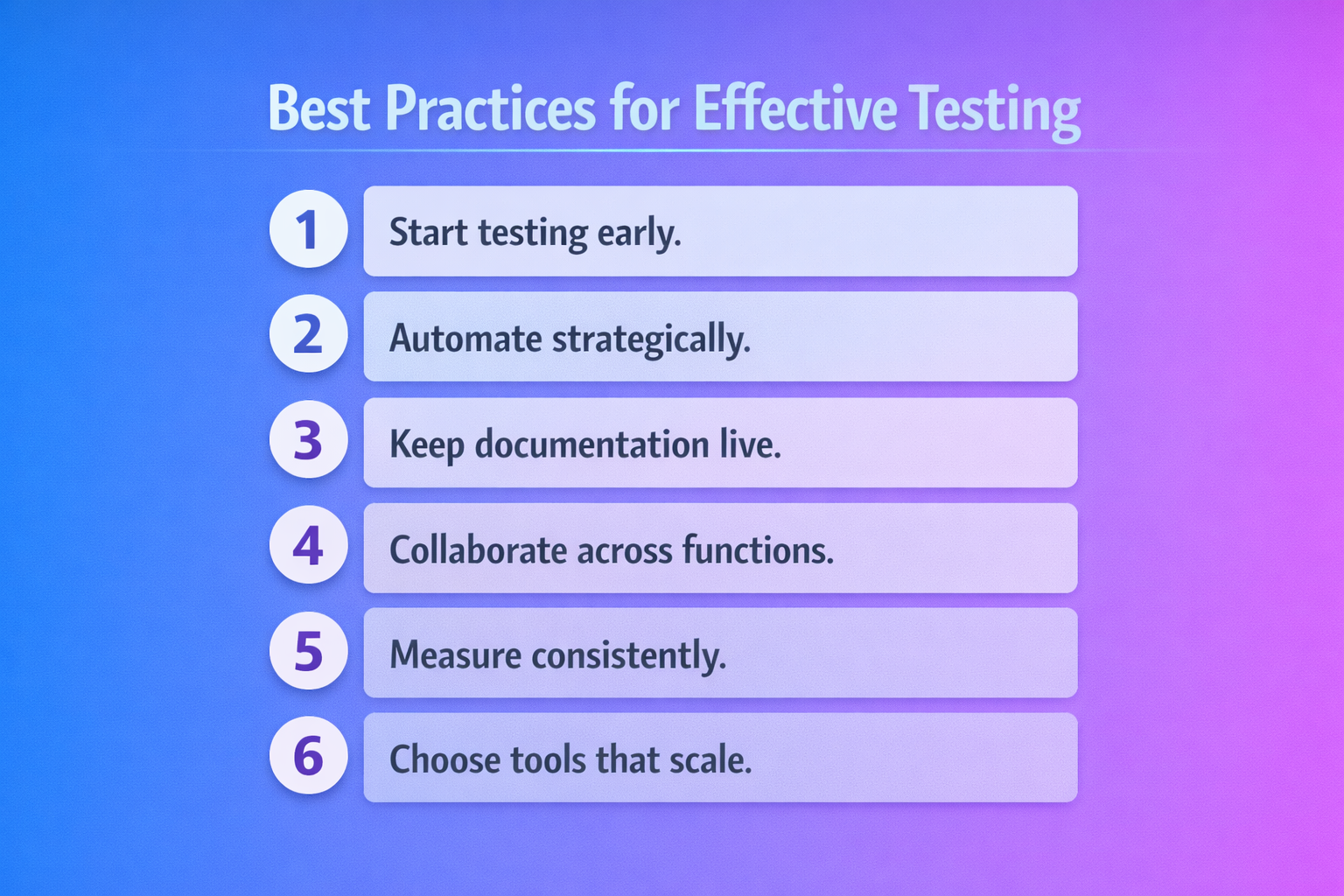
Consistent quality comes from process discipline, not just individual effort. These best practices define how high-performing QA teams operate across the stages of software testing:
- Start early. Involve QA from the requirements phase. Shifting left dramatically reduces defect costs.
- Prioritize by risk. Focus coverage on areas where failures cause the most business impact.
- Automate strategically. Use automation for stable, repetitive scenarios like regression and smoke tests. Reserve manual effort for exploratory work and new features.
- Keep documentation live. Test cases, plans, and reports need continuous updates, not one-time creation.
- Collaborate across functions. A tester embedded in cross-functional discussions catches issues earlier and builds shared ownership of quality.
- Measure consistently. Track defect escape rate, test coverage, and cycle time. Use the data in retrospectives to drive real improvements.
- Choose tools that scale. Modern test management platforms reduce manual overhead, improve traceability, and support growth in product complexity.
Conclusion
A structured QA testing process is what separates confident releases from reactive firefighting. Each stage of the STLC builds on the last, creating a system where quality is built in from the start. Teams that invest in this process ship faster, catch defects earlier, and deliver software their users can rely on.