

Everyone loves a good welcome bonus. Players see extra value, operators attract new customers, and everybody seems happy. At least until someone decides to create ten accounts, borrow a cousin’s identity, connect through a VPN, and collect the same promotion again and again. That is where modern behavioral AI quietly steps onto the stage.
Today, online betting platforms are not just set up by matching email addresses or IP numbers. In the last decade, fraudsters have gotten ever more adept, and operators have had to follow suit. Today, AI learns behavior, rather than only one fact. What an interesting change, as computers now recognize suspicious behavior with almost the same acumen and skill as seasoned investigators.
Machine Learning Does Not Seek Single Clues, but Rather Patterns
Much of this evolution is powered by machine learning. Machine Learning Models look at vast amounts of historical data instead of adhering to a set of instructions. They get an idea of how customers typically behave and how bonus abuse is likely to appear. Each and every login, deposit, click, betting pattern, and withdrawal request is a little piece of a large puzzle.
Often, it’s companies that focus on fighting against fraud in online gambling that provide interesting examples, like SEON, Sumsub, or Featurespace. Their systems are capable of incorporating hundreds of signals to determine the chances of an account being a legitimate player or a promoter exploit. Rather than declaring the account a fraud, they typically give it a score based on risk which the humans can do a review on before taking any action.
It’s not just device fingerprinting that reveals more than you think.
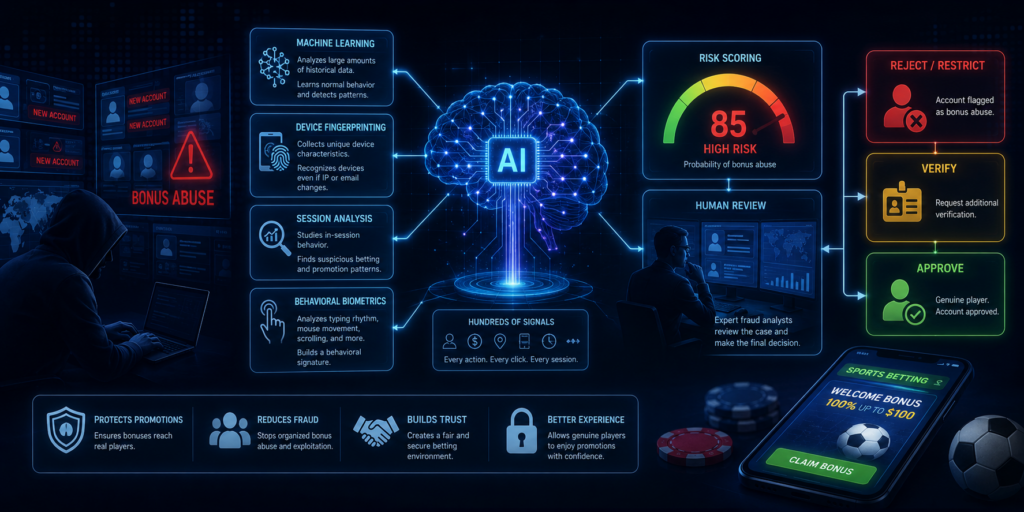
Today, device fingerprinting is one of the most valuable tools in the industry. Somewhat complicated but very practical.
Dozens of technical attributes are left behind by every smartphone, tablet or computer. Screen resolution, operating system, browser version, fonts installed, language settings, time zone, graphics processor and more are a one-of-a-kind combination. If they change their IP address or they create a new email account, their device seems very familiar.
Responsible platforms know, however, that there is no ideal fingerprint. Two family members can share one laptop and one player can have multiple laptops for the week. Behavioral AI, however, doesn’t look at device fingerprinting as the only indicator of abuse, but rather one part of the puzzle.
Session Analysis Connects the Dots
Session analysis adds another layer of intelligence. Instead of asking only who logged in, AI also studies how the person behaves during the session.
Does the player immediately claim every available promotion before disappearing? Do they always deposit exactly the minimum amount required for bonuses? Are they placing mathematically conservative bets designed only to unlock bonus conditions as quickly as possible? Do dozens of newly created accounts follow almost identical navigation paths within seconds of registration?
Humans could spot some of these patterns manually. But when millions of betting sessions occur every day, AI becomes far more efficient.
Around the middle of this technological evolution, another interesting discussion has appeared across North America as regulated markets continue expanding. Anyone researching a casino platform like the casino platform Alberta will quickly notice that modern licensed operators increasingly advertise advanced security measures alongside responsible gambling tools. It may not be the first feature players look for, but sophisticated fraud detection helps protect promotional offers so that honest customers continue benefiting from them instead of seeing bonuses disappear because of widespread abuse.
Behavioral Biometrics Add Another Layer of Security
Behavioral biometrics pushes the technology even further. This field examines how someone interacts with a website rather than simply what they do.
Researchers have shown that typing rhythm, mouse movements, scrolling speed, touchscreen gestures, and hesitation between clicks can reveal consistent behavioral patterns. Financial institutions have used similar techniques for years to combat online banking fraud, and betting companies have gradually adopted comparable approaches. A fraudster controlling dozens of accounts often behaves differently from a casual sports fan relaxing after work.
The impressive part is that these systems rarely depend on one suspicious event. They combine hundreds or even thousands of small observations. A single unusual login means very little. But twenty unusual signals appearing together can paint a very different picture.
Finding the Right Balance
Naturally, this raises an important challenge. Nobody wants legitimate players to lose access to their accounts because an algorithm became overly cautious.
False positives remain one of the biggest concerns in behavioral AI. Imagine siblings living together, sharing Wi-Fi, placing bets on the same football match, and both accepting identical welcome bonuses. From a purely technical perspective, several warning signs suddenly appear. Yet nothing dishonest has actually happened.
That is why reputable betting operators usually combine automated detection with human review. AI highlights unusual cases, but experienced fraud specialists often make the final decision. Many companies also request additional identity verification before applying permanent restrictions, giving honest players an opportunity to confirm who they are.
The balance between fraud prevention and customer experience has become just as important as detection accuracy itself. An overly aggressive system frustrates loyal users. A system that is too lenient encourages organized bonus abuse. The most successful operators continuously retrain their machine learning models as player behavior evolves and new fraud techniques emerge.
Technology That Benefits Everyone
Interestingly, many ideas developed inside the gambling industry now influence fraud detection elsewhere. Banks, e-commerce platforms, fintech companies, cryptocurrency exchanges, and even online marketplaces increasingly use behavioral analytics inspired by similar principles. Criminals constantly adapt, so defensive technology must evolve just as quickly.
Behavioral AI will probably never eliminate bonus abuse completely. Someone will always invent another creative trick. But by combining machine learning, device fingerprinting, session analysis, and behavioral biometrics, betting platforms have become remarkably effective at separating genuine customers from professional bonus hunters.
Perhaps the biggest success is not catching more fraudsters. It is allowing honest players to enjoy promotions with greater confidence, while operators protect their business without treating every new customer as a suspect. That balance is exactly where modern artificial intelligence delivers its greatest value.