
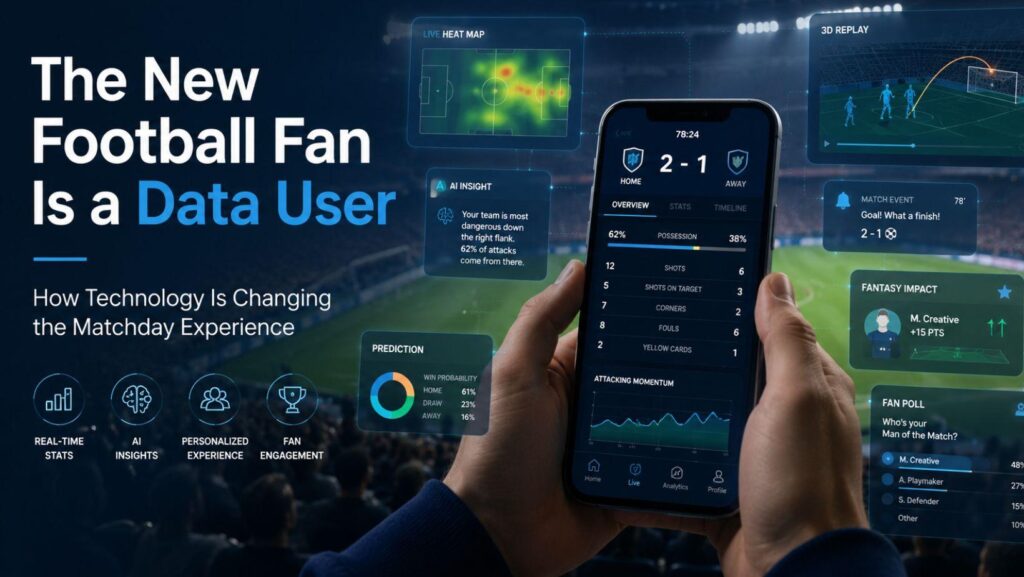
The modern football supporter consumes the match as a data stream. At the FIFA World Cup 2026, fans in a single stadium generated 45.1TB of mobile traffic and 8.4TB of Wi-Fi traffic during one game, and FIFA moved 13 million gigabytes across its tournament and broadcast networks. The 90 minutes are the same length they have always been. Everything wrapped around them has changed shape.
That shift has a name in the industry, second screen, and a much less tidy reality. The fan is not simply watching television with a phone nearby. They are checking a live win probability, comparing a striker’s expected goals with a friend in a group chat, watching an offside animation on the stadium big screen, and adjusting a fantasy captain before the next kick-off. The match has become an interface.
What the 2026 World Cup proved about how fans watch
The first 48-team tournament produced the clearest measurement yet of digital fandom at scale. FIFA reported stadium occupancy of 99.7% with more than 6.25 million fans attending, alongside 20 billion video views across its own platforms, 161,000 kilometres of fibre deployed and those 13 million gigabytes of network traffic. Verizon installed private 5G across all 16 venues.
The load profile is the interesting part. Analysis of tournament connectivity found that a single match also carried more than 650,000 voice calls, with 32,000 roaming subscribers adding pressure to international signalling. Network traffic synchronises around goals, penalties and controversies, which means the infrastructure is not sized for the average of a match but for the six or seven seconds after something happens.
Venue Wi-Fi data from Purple, which operates public Wi-Fi across host cities, added a behavioural detail that no broadcaster would have predicted. Connections in Los Angeles rose 171% on match days compared with non-match days, Miami rose 78%, and one host-city venue recorded its busiest match day when the United States played, with roughly 8,000 connected fans against 4,500 to 5,400 for matches between other nations. Fans arrive connected, and they stay connected after the whistle.
Referee View turned officiating into fan content
Referee View is the clearest example of a refereeing tool sold as entertainment. A lightweight camera mounted on the head of the main official captures a first-person view, which is transmitted in real time and cut live into the broadcast. It was first trialled at the FIFA Club World Cup in 2025 and rebuilt for 2026 with AI stabilisation from Lenovo, FIFA’s technology partner, reducing jitter by up to 50% in high-motion sequences. It ran in every group-stage match.
Fans noticed. Lenovo’s survey of supporters across Australia, Canada, India, the United Kingdom and the United States found that 76% had seen or heard about Referee View, 91% found the close-to-action perspective appealing, and 87% said technology is improving their viewing experience. Broadcasters used the feed for goals, penalty decisions and pre-match handshakes.
The framing matters more than the camera. FIFA presents this as transparency, a way to show what the official saw. The broadcast use is closer to immersion, a camera angle nobody could buy before. Both are true at once, and that dual purpose is exactly why the technology got funded.
The 3D avatar changed what a replay is for
Semi-automated offside has existed for several years. What 2026 added was presentation. Players are scanned in roughly a second to build accurate 3D models, which combine with ball and camera tracking so that officials can pinpoint the moment of contact and each player’s position at that instant. The decision output then appears in stadium replays and on the global broadcast as an animation of the call rather than a frozen frame with a flat line drawn across it.
Read that as a media decision, not an officiating one. The replay used to be evidence shown to a referee. It is now a short piece of explanatory content shown to a crowd of 70,000 and an audience of hundreds of millions, designed to be understood in four seconds by someone who has never read a law of the game.
Nobody actually knows how many fans use a second screen
This is where most articles on the subject go wrong. Published figures for second-screen use among sports fans range from 14% to over 90%, and the spread is a definition problem rather than a measurement problem. Some surveys count any device in the room, others count a deliberate task related to the match.
The usable numbers are the specific ones. Deloitte’s fan research found that 77% of fans do at least one additional activity related to a game while watching from home. Nielsen, heading into the World Cup, reported that 79.4% of US football fans engage on second screens during matches, rising to 86% of Millennials and 83.2% of Gen Z, and that US viewers spent nearly 80 billion minutes watching football in 2025. When you see a single headline percentage quoted with no source attached, it is usually the highest number someone could find.
Fantasy and prediction became the default grammar of engagement
The official FIFA World Cup Fantasy game, powered by Aramco, launched on 26 May 2026, free to play, with a 15-player squad built under a $100 million budget that rose to $105 million from the Round of 32. Fans were selecting from a record 1,248 registered players. The mechanic is old. Its function is new, because fantasy converts a neutral group-stage match between two teams you do not support into a personal stake worth watching.
The same logic runs through prediction leagues, pick’em games and live betting markets, all of which are fed by the same real-time data pipelines that populate the stats tab in the official app. From the fan’s side there is no visible boundary between checking a player’s shot map, submitting a prediction and looking at a live market. From a regulatory and product side those are entirely different activities with different duties attached, and the seamlessness is deliberate. It is worth naming that plainly, because the design intent is to keep attention inside one loop.
Personalisation is the product being built
The official tournament app bundles live scores, formations, player ratings, advanced stats, fantasy games, highlights and a feed personalised around the teams you follow. Lenovo’s Smart Wayfinding extended the same idea outside the ground, mapping fan zones, venues and points of interest with AI-guided navigation.
The commercial logic is the part fans do not see. Reported figures from the tournament put FIFA.com at 130 million unique visitors during the group stage and the official app at 30 million, an increase of around 130% on the previous tournament. Those are not audience numbers in the broadcast sense. They are logged-in relationships, with consent, preferences and contact details attached, which is why every federation, league and club is building an app it does not strictly need.
What it costs
A connected matchday fails when the connection fails. Short outages at a stadium now produce the kind of public reaction that used to be reserved for a refereeing error, because a fan who cannot load a mobile ticket is a fan who cannot get in. Attention is the other cost. A supporter running five data streams during a match is engaged by every metric a rights holder tracks, and may still be watching less football than the person next to them who is just watching.
The honest summary is that the technology has made the game more legible and more crowded at the same time. Next time you watch a match, count how many separate screens or tabs you touch before half-time. Which of them actually made you understand the game better?