
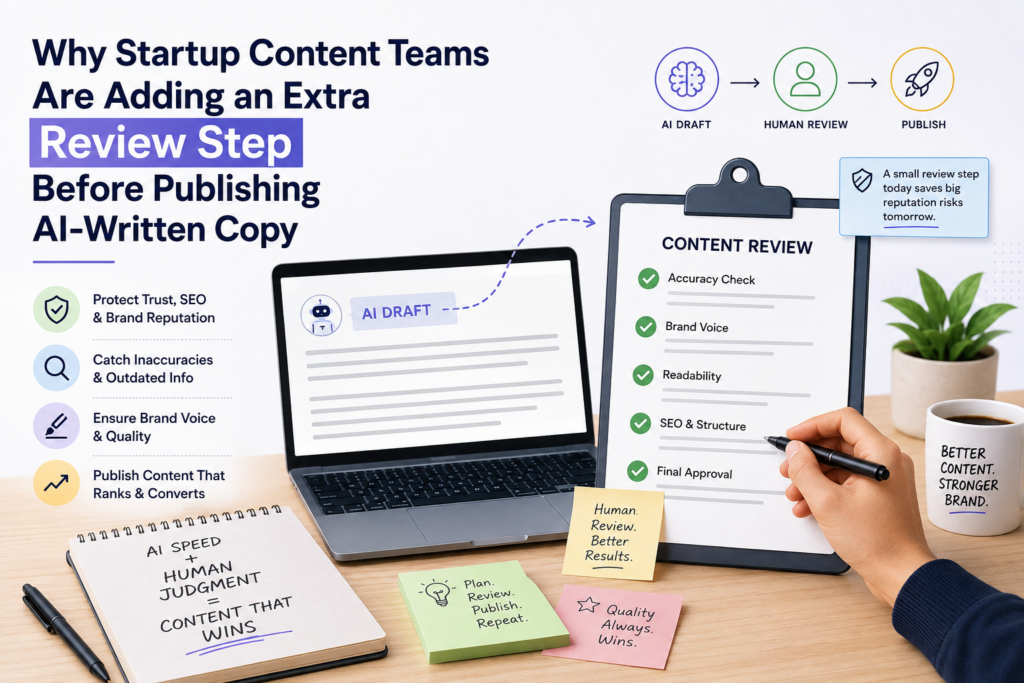
Something has shifted in how startup content teams handle AI-written drafts. A year ago, most teams were racing to publish AI content at scale. Today, more of them are hitting pause before anything goes live.
Publishing raw AI output is starting to cost startups more than it saves.
Google’s helpful content updates, reader trust, and brand consistency have forced a rethink of every AI content strategy across the startup ecosystem. An extra review step is now the norm at teams that care about long-term traffic.
It’s not slow. It’s not old-fashioned. It’s how modern startups operate lean without hiring first and protect the credibility they’ve spent months building.
You’ll see exactly why the shift is happening, what the review layer looks like in practice, and how to bake it into your workflow without slowing your team down.
Key Takeaways
- Raw AI drafts often miss brand voice, current facts, and search intent.
- A short review step protects trust, SEO rankings, and legal exposure.
- Startups are treating AI as a first-draft engine, not a publisher.
- An effective AI content strategy blends automation with human judgment.
- Even a light-touch review cuts revisions and rework by half.
The Shift Behind the New AI Content Strategy
A few years ago, “publish faster” was the whole pitch. Startup content teams turned prompts into posts in minutes. Volume looked like a win.
Then the results came in.
Traffic dips. Reader complaints. Occasional factual errors that made it into public releases. Search engines got sharper about spotting thin, formulaic writing, and readers got quicker at closing tabs.
So the modern AI content strategy isn’t about production speed anymore. It’s about production quality at speed. Your team ships fast, but nothing goes out without a second set of eyes.
This shift lines up with how startups scale everything else. Code goes through review. Product ships behind feature flags. Financial reports get double-checked. Content is finally catching up.
You’ll notice the change most in early-stage teams that used to skip QA to hit publishing quotas. Now they realize a single bad post can undo weeks of trust. An extra review step is cheap insurance for an AI content strategy that already leans heavily on machines.
There’s also a competitive angle. Every startup in your space has access to the same models you do. Prompt quality is converging fast. The differentiator now isn’t which tool you use. It’s the layer of judgment you add on top of it.
That judgment is what turns a decent draft into a post readers actually finish. It’s also what search engines increasingly reward as they get better at spotting original perspectives versus rehashed model output. A durable AI content strategy leans into that reward rather than fighting it, and the smartest teams are already thinking about where AI language infrastructure is heading so their process ages well.
Where AI-Written Copy Usually Falls Short
Even the best model isn’t your teammate. It doesn’t know your customer, your last product launch, or your founder’s stance on a topic. That gap shows up in the drafts.
Here are the five cracks reviewers spot most often:
- Vague claims that sound smart but aren’t backed by anything real.
- Outdated statistics pulled from stale training data.
- Brand voice that drifts toward corporate mush.
- Repeated ideas rephrased across paragraphs.
- Search intent that misses what your audience actually types.
None of these are dealbreakers alone. Stack them, and you’ve published a post that feels off. Readers can’t always name the problem, but they feel it, the same way they feel how poor usability ruins great products without being able to articulate exactly what’s wrong.
A smart AI content strategy treats these gaps as expected, not exceptional. You plan for them. You build a review checkpoint that catches them before publishing.
Startups that skip this step usually end up with a content library nobody links back to. That’s a rough return on the hours you spent generating drafts.
Building an AI Content Workflow That Doesn’t Burn Out Your Team
An AI content workflow with a review layer isn’t just editing. It’s a system.
Here’s what a lean one looks like.
- Brief: You define audience, angle, keywords, and voice before generating anything.
- Draft: AI produces the raw version against your brief.
- Fact-check: A team member verifies stats, quotes, and product details.
- Voice pass: Someone rewrites lines that sound generic or off-brand.
- SEO polish: You optimize headers, meta, and internal links.
- Final sign-off: One person owns the publishing decision.
Each stage takes minutes, not hours. The whole AI content workflow can wrap in under 90 minutes for a 1,500-word post if the roles are clear.
The point isn’t to add friction. It’s to catch problems while they’re still cheap to fix. A misplaced statistic caught pre-publish is a small edit. The same mistake caught post-publish is a retraction, a Slack thread, and a client email.
Building this AI content workflow once saves you dozens of scrambles later. It also gives new hires a clear playbook, which matters more than most founders realize when the team doubles in six months.
What the Extra Review Step Actually Looks Like
The review layer isn’t one thing. It’s a handful of small checks stacked in the right order.
You want your reviewer asking:
- Does the intro match the headline promise?
- Are all statistics current and sourced?
- Does the writing sound like a human wrote it?
- Are keywords placed naturally, not stuffed?
- Do the transitions actually flow, or do sections feel bolted together?
- Would a real reader trust this piece?
That last question is the most important. Trust is what AI can’t fake, and it’s what readers respond to when they decide whether to subscribe, share, or ignore.
Tooling helps too. Plenty of teams run their drafts through an AI humanizer before human review even starts. It smooths out the giveaway patterns that make text read as machine-generated, so your reviewers spend their attention on facts and voice instead of line-level cleanup.
You still need a person after that. The tool speeds the process. It doesn’t replace it.
A good rule of thumb is to time-box the review. Give your reviewer a firm ceiling per piece, say, forty-five minutes for a long-form post. That forces discipline. It also stops the review from expanding into a full rewrite, which is the fastest way to burn out anyone you assign to this role.
Some teams rotate the reviewer role weekly. Others assign it permanently. Both work. What matters is that the person doing the review isn’t the same person who wrote the brief or generated the draft. Independence is the whole point of the AI content workflow.
Common Mistakes to Avoid in Your AI Content Strategy
Even teams that add a review step still trip up. Watch for these five patterns:
- Treating review as proofreading. The value is in fact-checking and voice, not typos.
- Letting the same person write and review. Fresh eyes catch what tired ones miss.
- Skipping the brief. Without direction, review becomes rewriting from scratch.
- Chasing word count over depth. AI can pad forever. Reviewers should cut.
- Ignoring reader signals. If bounce rates climb on AI-assisted posts, your process needs work.
The best AI content strategy is one your team can actually run week after week. Overengineer it, and you’re back to the slow pace you were trying to escape in the first place. Think of the review layer as basic risk management for startups, not a bureaucratic checkpoint.
Simple beats fancy every single time.
One more thing worth flagging. Don’t let your AI content workflow become a bottleneck at the review stage. If drafts pile up waiting for a single reviewer, the whole system stalls. Distribute the load. Give more than one person on the team the authority to sign off, using the same checklist. That way, volume scales even when someone is on vacation.
The Bottom Line
Startup content teams aren’t slowing down. They’re getting sharper about where they spend their attention.
A review step is no longer a luxury reserved for enterprise publishers. It’s how modern startups protect the trust that fuels their growth. Any AI content strategy worth running today includes a human checkpoint before publishing.
You don’t need a big team or a fancy process. You need clear roles, a short checklist, and one person who gives the final approval.
Do that consistently, and your AI-assisted content will outperform teams still racing to publish raw drafts. Slow enough to be right, fast enough to stay competitive.
Frequently Asked Questions
1. Should you publish AI content without any human review?
No, and it’s getting riskier by the month. Even short posts benefit from a quick review pass because search engines and readers both reward original voice and accurate facts. Google’s helpful content system explicitly downgrades pages that feel machine-generated and unedited, which means unreviewed AI drafts can quietly drag down the rest of your domain over time.
There’s a business risk too. A single factual error in a published post can trigger customer complaints, legal review, or, in regulated industries, actual fines. The minutes you save by skipping review are almost never worth the cleanup cost when something slips through. Treat human review as a non-negotiable pillar of your AI content strategy, even for internal newsletters and social captions.
2. How long should the review step take for a 1,500-word article?
Thirty to forty-five minutes is the sweet spot for a trained reviewer. Fact-check, voice pass, and SEO polish can all happen in one focused sitting. You’re refining, not rewriting from scratch. If a review is regularly taking longer than ninety minutes, the problem is upstream. Your brief is probably too thin, or your prompts aren’t specific enough to produce a usable first draft.
For shorter formats like landing page copy or email sequences, ten to twenty minutes is plenty. The goal is to catch the three or four things that would embarrass you if a reader spotted them first. Anything beyond that is diminishing returns and slows your AI content workflow down for no real quality gain.
3. What’s the biggest sign my AI content workflow needs an upgrade?
Rising bounce rates and falling time-on-page are the earliest warnings. If readers land on your posts and leave within twenty seconds, the drafts aren’t earning their attention. That’s usually a voice or intent problem, and no amount of keyword optimization will fix it.
Other signals to watch for include a shrinking share of backlinks from other sites, a drop in social shares even when traffic is steady, and internal feedback that your content “sounds the same” across topics. Any two of those together mean your review step is either missing or too shallow. Rebuild the checklist, assign clear ownership, and give the reviewer permission to send drafts back rather than fixing them silently.
4. Can AI tools handle the review step themselves?
Partly. Tools are excellent for the first pass on grammar, readability, and detection of overly robotic phrasing. They can flag repetitive sentence structures, spot missing citations, and even suggest better transitions. That’s real value, and it saves your human reviewer meaningful time.
But tools can’t judge whether a claim is actually true, whether the angle fits your brand’s point of view, or whether a reader in your specific niche will find the piece useful. Those are human calls, and they sit at the heart of any credible AI content strategy. The strongest AI content workflow uses tools for the mechanical layer and reserves human attention for the judgment layer. Trying to automate the whole review is how startups end up with content that’s technically clean but strategically empty.