
Crypto Betting Isn’t a Side Hustle Anymore
Ask any founder building in fintech right now, and they’ll tell you the same thing: crypto payments stopped being a novelty around 2023 and turned into an expectation. Sportsbooks and online casinos felt that shift early. Bettors want instant settlements, they want low fees, and – perhaps most of all – they want to skip the awkward conversation with their bank about a gambling transaction. That’s the backdrop against which Canadian crypto betting platforms have been quietly reshaping their product lines throughout 2025 and into 2026.
One platform that keeps showing up in these conversations built its reputation across several markets by combining traditional sportsbook depth with crypto-native flexibility – not always an easy balance to strike, since sportsbooks need liquidity and speed, while crypto rails demand security and transparent settlement logic. A growing share of online bettors, particularly younger ones, now say they’d prefer a crypto deposit option if one were available. That shift explains why so many operators have rushed to retrofit crypto wallets into platforms that were, not long ago, built purely around Interac and credit cards.
For the Canadian market specifically, that positioning rests on three pillars: sports betting coverage, a crypto-friendly casino lobby, and payment infrastructure that doesn’t force users to convert their holdings back into fiat every time they want to place a wager. Ontario’s regulated market – one of the few in Canada with a formal licensing framework through iGaming Ontario – has made this kind of positioning trickier than it sounds. Operators need to satisfy compliance requirements while still delivering the “crypto-native” experience players expect. That tension is exactly where the platform’s engineering choices matter most.
What the Sportsbook Side Actually Offers
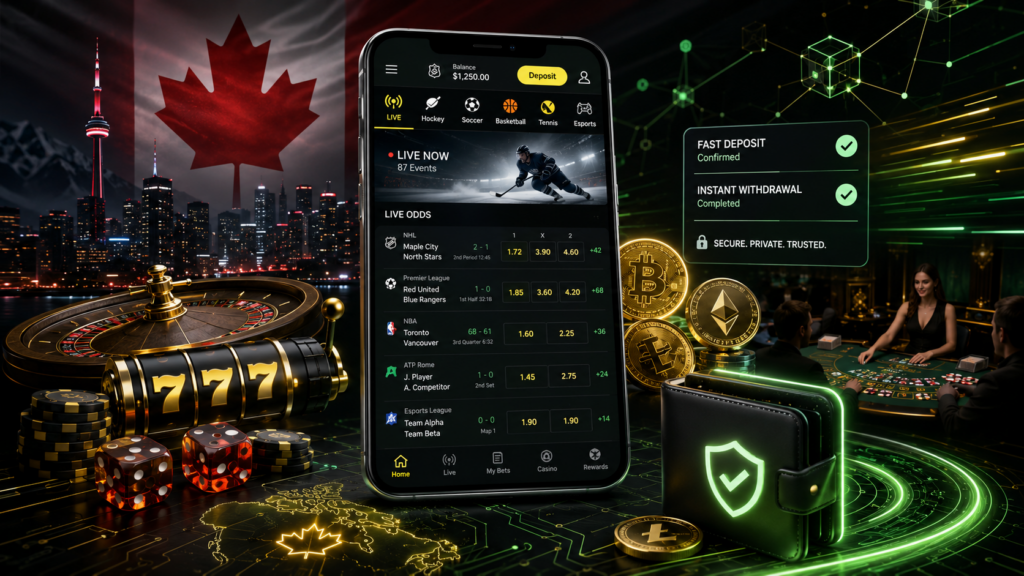
On Parimatch, the betting menu spans the usual suspects – hockey (unsurprisingly, given the audience), soccer, basketball, tennis – alongside a noticeably deep esports section covering CS2, Dota 2, and League of Legends tournaments. A few things stand out:
- Live betting markets update fast enough to keep pace with in-game momentum shifts, which matters a lot during hockey’s third-period chaos.
- Cash-out options let bettors lock in partial winnings before an event ends, a feature that’s become table stakes rather than a differentiator.
- Crypto-denominated odds are displayed alongside CAD equivalents, so users aren’t stuck doing mental math mid-bet.
A useful way to frame where crypto sportsbooks are competing in 2026: less on flash, more on plumbing. The operators gaining traction generally aren’t the ones with the flashiest interface – they’re the ones who settled the unglamorous question of “how does money move” before layering on the fun stuff.
The Casino Lobby: Familiar Games, Different Rails
On the parimatch canada casino side, the library leans heavily on providers already trusted across European and Latin American markets – think Pragmatic Play slots, Evolution live-dealer tables, and a rotating set of provably fair crypto-native games that let players verify outcomes independently rather than trusting a black box. That “provably fair” mechanic has quietly become a selling point for crypto casinos generally; it’s one of the few areas where blockchain’s transparency actually solves a real trust problem instead of just sounding good in a pitch deck.
Faster withdrawal times are commonly cited as the main draw pulling bettors toward crypto rails, especially among esports audiences who tend to be early adopters of new payment tech. Whether that pattern holds across the broader Canadian market is still an open question – adoption curves in gambling tech tend to be lumpy, driven as much by regulatory clarity as by user preference.
Where This Fits Into the Bigger Picture
Canada’s relationship with crypto gambling remains a patchwork. Ontario has its licensing regime; other provinces operate under looser or still-evolving rules. That regulatory unevenness is precisely why platforms built around flexible crypto rails have an edge – they can adapt payment logic province by province without rebuilding core infrastructure each time. It’s not a flashy advantage. It’s the kind of unglamorous, structural decision that tends to separate platforms that last from ones that don’t.
For founders and product teams watching this space from the outside, there’s a broader lesson buried in here about infrastructure-first thinking. Crypto sportsbooks succeed or fail less on marketing spend and more on whether the underlying rails – settlement speed, compliance logic, wallet security – were built with the same rigor as the front-end experience. Betting platforms are, in the end, fintech products wearing a sportsbook’s clothing.
Final Thoughts
The direction of travel here isn’t ambiguous: Canadian bettors are pulling crypto rails into a market that, until recently, ran almost entirely on traditional payment methods. Platforms that treat that shift as a plumbing problem – not just a marketing one – tend to hold up better once the initial novelty wears off. Whether that translates into long-term loyalty from Canadian users is still playing out, but the early signals point toward crypto-friendly infrastructure becoming a baseline expectation rather than a bonus feature.