

Lean startup teams move fast. They often work with a small budget, limited staff, and tight timelines. One person may handle sales, support, product feedback, admin tasks, and customer follow-ups at the same time. This can make it hard to answer every call and respond to every customer quickly.
For early-stage teams, every conversation matters. A missed call can mean a missed lead. A delayed response can mean lost feedback. A poor follow-up can slow down growth. This is why many lean startups are using AI voice agents to support daily work.
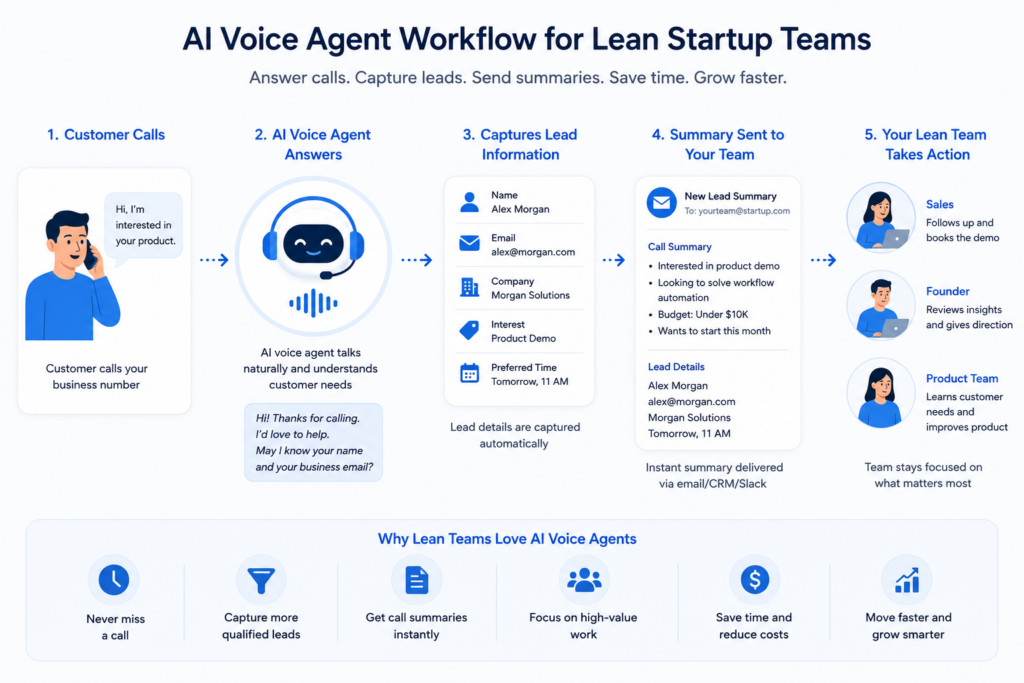
An ai voice agent can answer calls, collect customer details, qualify leads, book meetings, and send call summaries. It helps small teams stay responsive without hiring a large support or sales team.
What Are AI Voice Agents?
AI voice agents are AI systems that can speak with people over calls. They can listen to customer questions, understand the request, respond in a natural way, and complete simple tasks.
They are different from old phone menus. Traditional phone systems ask callers to press numbers. AI voice agents allow people to speak naturally. For example, a caller can say, “I want to book a demo,” and the AI can ask for the right details.
Startups can use AI voice agents for sales calls, support calls, demo booking, lead qualification, customer feedback, and follow-ups.
Why Lean Startup Teams Need Smarter Call Support
Lean teams cannot afford to waste time. Founders and team members are often focused on product development, customer research, sales, and operations. When calls come in, it is not always possible to answer them right away.
But early-stage startups cannot ignore calls either. Calls can bring new leads, user feedback, partnership requests, support issues, and product ideas. If these calls are missed, the team may lose useful information.
AI voice agents help by keeping the business available. They can answer basic calls, collect details, and pass useful summaries to the team. This allows founders to stay focused while still learning from customers.
This is also why many founders now use AI tools for early founders to reduce manual work and stay focused on product, sales, and customers.
Reducing Manual Work for Small Teams
Lean startups need to reduce repeated tasks. For many startups, the goal is to operate lean without hiring first, especially when the team is still testing its product, market, and sales process. AI voice agents can handle simple call work that usually takes time from the team.
They can answer common questions, capture customer details, book demo calls, create support tickets, send follow-up notes, and route urgent calls. This reduces manual work and helps the team spend more time on important tasks.
This fits naturally because the section explains how lean teams reduce workload without hiring too early.
For example, instead of answering the same pricing or demo question many times, the AI can collect the request and send the details to the right person. The team can then follow up with better context.
Helping Founders Capture More Leads
For a startup, every lead is important. Many early-stage companies cannot afford slow response times. If a lead calls and nobody answers, that person may move to another company.
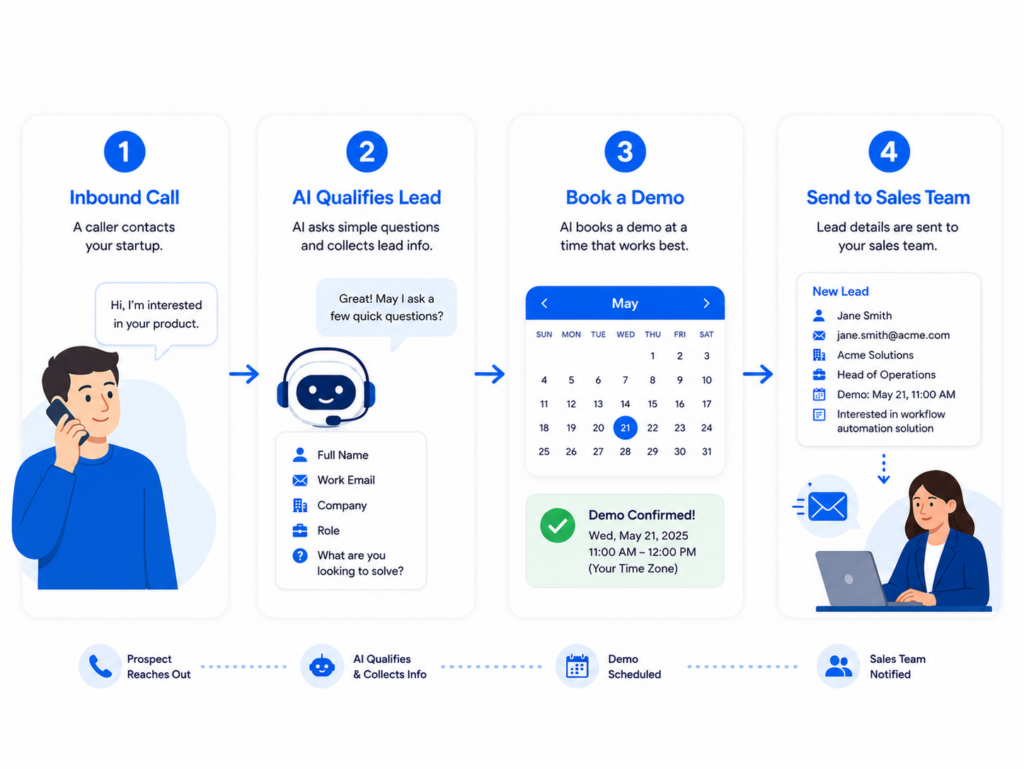
AI voice agents can answer lead calls quickly and collect key details. They can ask for the caller’s name, company, email, phone number, business need, budget, timeline, and preferred meeting time.
This makes follow-up easier. Sales teams can focus on qualified leads instead of spending time chasing incomplete information. It also helps founders understand what type of customers are showing interest.
Supporting Customer Discovery Calls
Customer discovery is a key part of the lean startup method. These customer calls are also useful when building an MVP because they show what users actually need before the team adds more features. Startups need to understand what users need, what problems they face, and what they expect from a product.
AI voice agents can support this process by collecting pain points, objections, and feature requests from calls. They can also create summaries that help founders review customer needs later.
These insights can guide product changes, website messaging, pricing, and sales scripts. When a team hears the same problem again and again, it becomes easier to decide what to improve next.
Improving Customer Feedback Loops
Lean startups grow through fast feedback. They build, test, measure, and improve. AI voice agents help make this loop faster by turning calls into organized feedback.
They can collect common complaints, repeated questions, pricing concerns, feature requests, and reasons why leads do not convert. This gives the team real information from customers, not just guesses.
For example, if many callers ask about one missing feature, the product team can review whether that feature should be added. If many leads ask the same pricing question, the team can improve the pricing page.
Booking Demos and Sales Meetings Faster
Startups often lose leads because scheduling takes too long. A customer may be interested today, but if the team replies two days later, the interest may be gone.
AI voice agents can ask qualifying questions and book demo calls. If connected with a calendar, they can help find a suitable meeting time. This reduces back-and-forth messages and keeps leads warm.
Faster demo booking is especially useful for SaaS startups, agencies, consultants, and B2B service companies.
Providing Basic Customer Support Without a Large Team
Many startups do not have a full support team in the early stage. Still, customers need help with login issues, billing questions, setup steps, product usage, and account problems.
AI voice agents can handle basic support calls and collect issue details. For complex problems, they can transfer the call or create a ticket for the team.
This helps startups offer better support without building a large department too early.
Supporting 24/7 Availability
Lean teams cannot always be available after hours. But customers may call at night, during weekends, or from different time zones.
AI voice agents can answer calls, collect requests, and schedule follow-ups when the team is offline. This makes the startup look more professional and responsive.
It also helps global startups serve customers across different regions without needing staff available all day.
Helping Teams Test Messaging and Offers
Startups often test different value propositions, pricing plans, and offers. AI voice agents can help track what customers ask, where they get confused, and what objections they raise.
These insights can improve website copy, pitch decks, product demos, sales scripts, FAQ pages, and pricing pages. Real customer language can make messaging clearer and more convincing.
Human Handoff Is Still Important
AI voice agents are useful, but they should not handle every call alone. Some calls need a human touch.
Human handoff is important for angry customers, sensitive issues, payment problems, complex support cases, and high-value leads. A good AI voice agent should know when to transfer the call and share a clear summary with the team.
This helps the customer avoid repeating the same details.
Best Practices for Lean Startup Teams
Start with one clear use case. Do not try to automate every call at once. Use simple call flows and train the AI with real customer questions.
Connect the AI voice agent with your CRM, calendar, or support tools if possible. Review call summaries every week. Update scripts based on customer feedback. Set clear rules for human handoff.
Most importantly, use AI to support your team, not replace customer understanding.
Conclusion
AI voice agents help lean startup teams stay small while moving faster. They support lead capture, customer discovery, feedback collection, demo booking, basic support, and after-hours availability.
For startups, the biggest value is not only automation. It is learning from every customer conversation. When used well, AI voice agents help teams save time, respond faster, and make better decisions based on real customer needs.
FAQs
How do AI voice agents help lean startup teams?
They help answer calls, capture leads, collect feedback, book meetings, and reduce manual work.
Can AI voice agents help with customer discovery?
Yes. They can collect customer pain points, objections, questions, and feature requests from calls.
Are AI voice agents useful for early-stage startups?
Yes. They help small teams handle more calls without hiring a large support or sales team.
Can AI voice agents replace a startup support team?
They can handle basic calls, but humans are still needed for complex and sensitive conversations.
What should startups check before using an AI voice agent?
They should check voice quality, call flow, integrations, summaries, data security, and human handoff.