
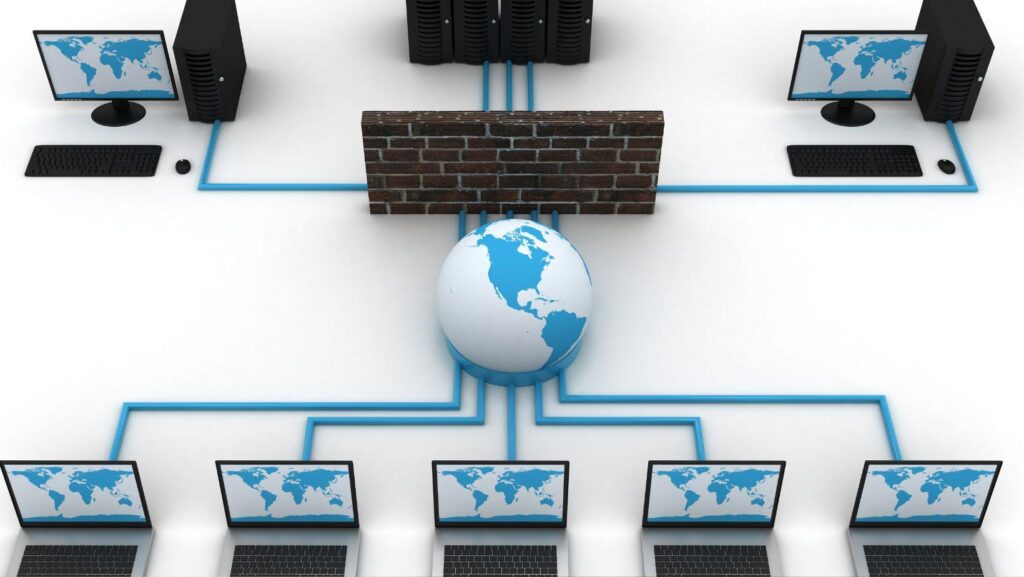
Industrial technology rarely fails under convenient conditions. For instance, inside a processing plant, the aging controllers exchange data with maintenance laptops, sensors, and the central IT system, often through protocols that weren’t designed with modern cyber threats in mind.
That’s where a ruggedized firewall earns its place: not simply by filtering packets, but by maintaining security controls where heat, dust, vibration, moisture, and unstable power would overwhelm standard security frameworks.
For industrial operators, the question isn’t whether a firewall has enough features on paper. It’s whether those controls will remain available at the edge, during poor weather, equipment faults, maintenance work, and an actual cyber incident. Failure there can affect machinery, employee safety, product quality, and operational continuity.
Why Industrial Networks Need Purpose-Built Protection
Most enterprise firewalls live in climate-controlled rooms with stable power and predictable cable runs. But industrial technology rarely has that kind of setup.
A firewall may need to sit inside a roadside cabinet, electrical substation, processing plant, rail installation, mine, or offshore facility. In such conditions, the temperatures fluctuate, fine particles enter enclosures, machinery creates persistent vibration, and some locations aren’t visited for weeks or months.
While these conditions vary, the design problem stays familiar: security equipment must protect the network without becoming its weakest physical component.
A ruggedized firewall addresses this mismatch through hardened enclosures, industrial power options, broader operating-temperature tolerances, and resistance to shock or vibration. Those characteristics aren’t cosmetic. If the device protecting a production cell repeatedly shuts down because a cabinet overheats, its inspection and segmentation policies have little operational value.
Where the Firewall Fits in an OT Architecture
A ruggedized firewall shouldn’t be dropped into a flat network and treated as a cure. Its value depends on placement, traffic policy, and the operational process behind it.
Segment Critical Zones
Industrial environments often contain programmable logic controllers, human-machine interfaces, engineering workstations, safety systems, cameras, sensors, and vendor access points. Allowing unrestricted communication between them creates unnecessary paths for malware and misuse.
A firewall can separate assets by function and consequence. For example, a packaging line doesn’t usually need open communication with a building-management network. Nor should a contractor’s laptop receive broad access simply because it has reached the plant floor.
Segmentation gives those older assets a protective boundary even when they can’t support modern endpoint controls.
Control Traffic, Not Just Addresses
IP-based allowlists are useful, but they’re often too coarse for operational networks. A permitted engineering station could still send an unexpected command or use a protocol in a way that disrupts production.
Where supported and properly tested, protocol-aware inspection can restrict communication by service, direction, device role, or command type. So, start cautiously because blocking a legitimate control message at the wrong moment can cause more damage than the traffic being investigated.
That’s why OT engineers need a seat at the rule-review table. The SOC can identify suspicious patterns, but operations staff understand whether a message is unusual, hazardous, or simply part of a seldom-used maintenance routine.
Build a Defensible Remote-Access Route
Remote support is unavoidable at many distributed sites. The risky part is letting that access grow organically through shared accounts, permanently open services, or contractor-installed equipment that gets forgotten.
So, route remote sessions through a controlled entry point. It requires named accounts, strong authentication, approved source locations, and access windows tied to actual work orders. After that, log the session and shut the path when persistent access isn’t required.
Now, maintenance teams may resist controls that add minutes to an urgent repair but the security leaders should address that friction during planning and not during an outage.
What to Evaluate Before Deployment
Before deployment, environmental ratings deserve attention but they shouldn’t dominate the conversation. The reason is simple: a device can survive the cabinet and still be wrong for the network.
So, teams assessing industrial-grade Ruggedized firewall solutions should examine five areas:
- Environmental fit: Confirm temperature range, ingress protection, vibration tolerance, mounting format, cooling requirements, and hazardous-location certifications where applicable.
- Power resilience: Review supported input ranges, redundant power options, surge behavior, grounding, and recovery after an abrupt loss.
- Industrial visibility: Check whether the device can identify the protocols and asset types actually used at the site.
- Failure behavior: Decide whether interfaces should fail open, fail closed, or remain isolated. There’s no universal answer. Safety and process consequences should drive it.
- Operational support: Confirm how firmware, configuration backups, logs, and replacement units will reach remote locations with limited bandwidth or staff.
Here, one question tends to expose weak designs: what happens when this firewall fails?
If nobody can explain the bypass procedure, spare-device location, configuration restore process, and escalation owner, the deployment isn’t ready.
Deployment Without Disrupting Production
The CISA Industrial Control Systems guidance notes that many legacy environments still use outdated operating systems and protocols without native encryption or authentication. It also identifies brownfield integration, where newer connected equipment is layered onto older infrastructure, as a distinct security challenge.
In an industrial environment, changing a component means working within a tight deadline, where undocumented connections are common. So, begin with a passive discovery where possible, and map communicating assets, protocol flows, dependencies, remote-access routes, and traffic that appears only during startup, shutdown, cleaning, calibration, or batch changes.
Next, build an initial policy from observed requirements rather than assumptions. Then run it in monitoring mode if the architecture permits. After that, review exceptions with control engineers, and then tighten access gradually.
The NIST Guide to Operational Technology Security recommends security measures suited to OT’s particular performance, reliability, and safety requirements, rather than a direct copy of enterprise IT practice. It covers OT topologies, common vulnerabilities, risk management, and tailored safeguards.
Testing should also cover more than ordinary traffic. Include equipment restart, link loss, power restoration, maintenance connections, policy rollback, high traffic volume, and loss of central management. Someone also needs to verify that alerts reach the SOC with enough context to act.
Treat the Firewall as an Operational Control
Once deployed, the device becomes a part of the industrial maintenance program, where configuration drift, expired certificates, stale accounts, unsupported software, and disabled logging can quietly reduce its value.
Then, review rules against active assets and current production needs, remove temporary access when the work ends, track firmware status, but don’t push updates straight into production, and test them against representative equipment and schedule changes with operations.
Incident response plans should account for local constraints too. Can staff isolate one production area without taking down the whole site? Or can they preserve firewall logs if the management link is unavailable? Or who has authority to block a connection when security and production teams disagree?
Now, these are not product questions; they’re governance questions, and incident reviews have a habit of finding them late.
Protection That Has to Survive the Plant Floor
A ruggedized firewall protects industrial technology infrastructure by combining network control with physical durability at the points where operational systems connect. Its real contribution comes from narrower trust zones, controlled remote access, useful traffic visibility, and a defined response path when something behaves unexpectedly.
Still, hardened hardware alone won’t protect a poorly understood network. Asset discovery, tested policies, maintenance discipline, and cooperation between security and operations matter just as much. When those pieces line up, the ruggedized firewall becomes more than equipment in a cabinet. It becomes a dependable boundary between a manageable incident and a production-level crisis.