

Hardware startups face a problem software teams rarely encounter: every design mistake can create a physical cost. A revised component may require new tooling, new materials, another production setup, and another round of testing. For startups developing thin metal components, chemical etching can reduce some of this early tooling risk by using digital patterns instead of dedicated hard cutting dies.
The goal is not to avoid manufacturing cost completely. It is to avoid committing too much capital before the design has been validated.
Why Hardware Prototyping Is Different From a Software MVP
Software teams can change code, deploy an update, and test again.
Hardware development follows a longer path:
Design → Material → Manufacturing → Assembly → Testing → Redesign
Every loop uses physical resources.
A startup may discover that a sensor opening is too small, a contact is positioned incorrectly, or a spacer needs a different profile. Even a small change can affect several surrounding components.
This makes early manufacturing flexibility especially valuable.
The Tooling Problem for Early-Stage Products
Traditional manufacturing methods can require significant tooling investment.
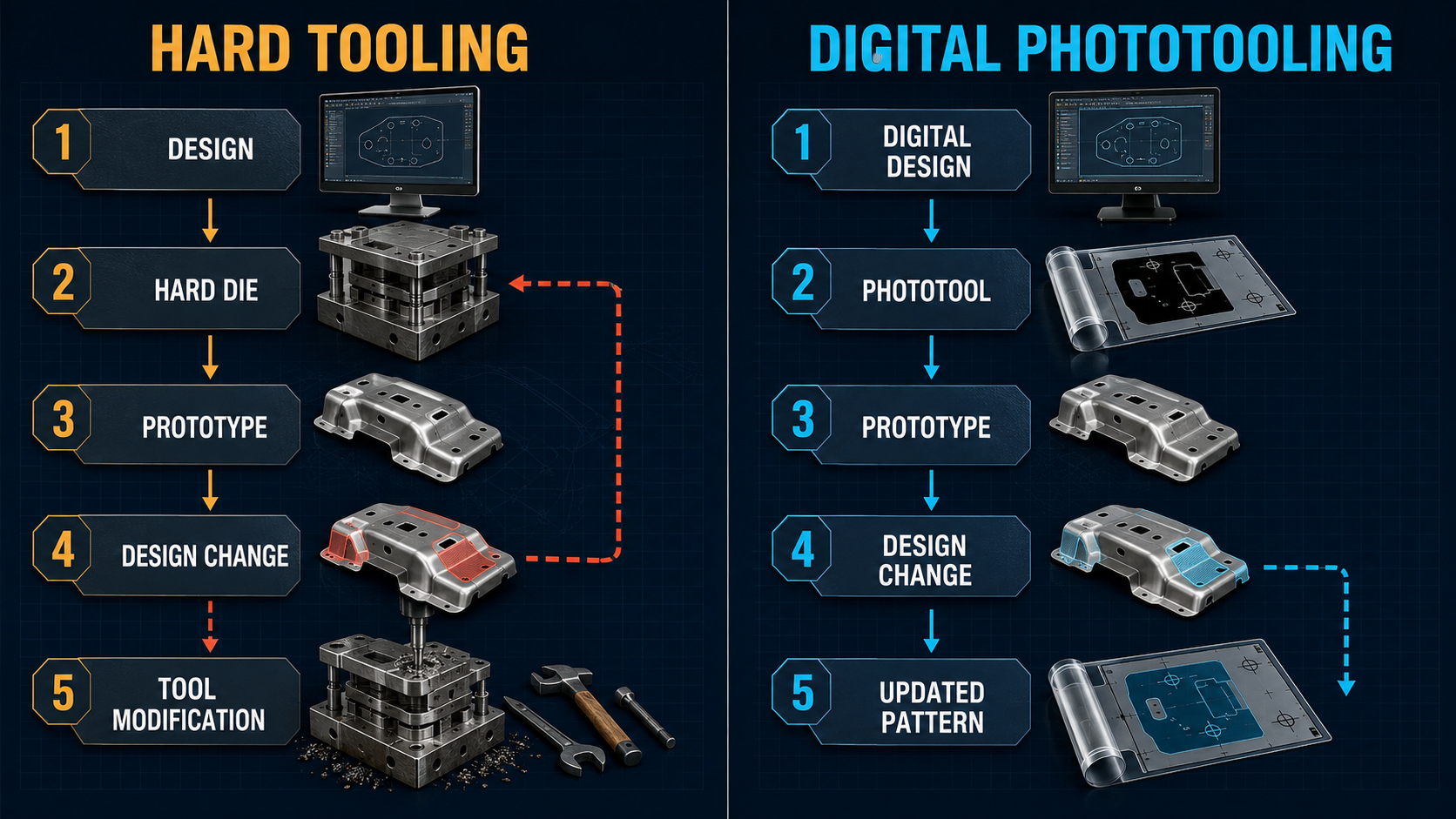
Stamping, for example, may use dedicated dies to cut or form a component. That can make sense once the design is stable and production volume is high.
The risk appears when a startup invests in hard tooling too early.
Imagine producing the first version of a thin metal contact. Testing then shows that two slots must move and the outer profile needs to change.
If the tool was built around the original geometry, the team may need to modify or replace it before producing the next version.
The cost of the mistake is no longer only engineering time. It becomes tooling cost as well.
Where Chemical Etching Fits
Chemical etching, also known as photochemical etching, removes selected areas from a sheet of metal using a controlled chemical process.
The component geometry is transferred from digital artwork onto a photoresist-coated metal sheet. An etchant then removes the exposed areas.
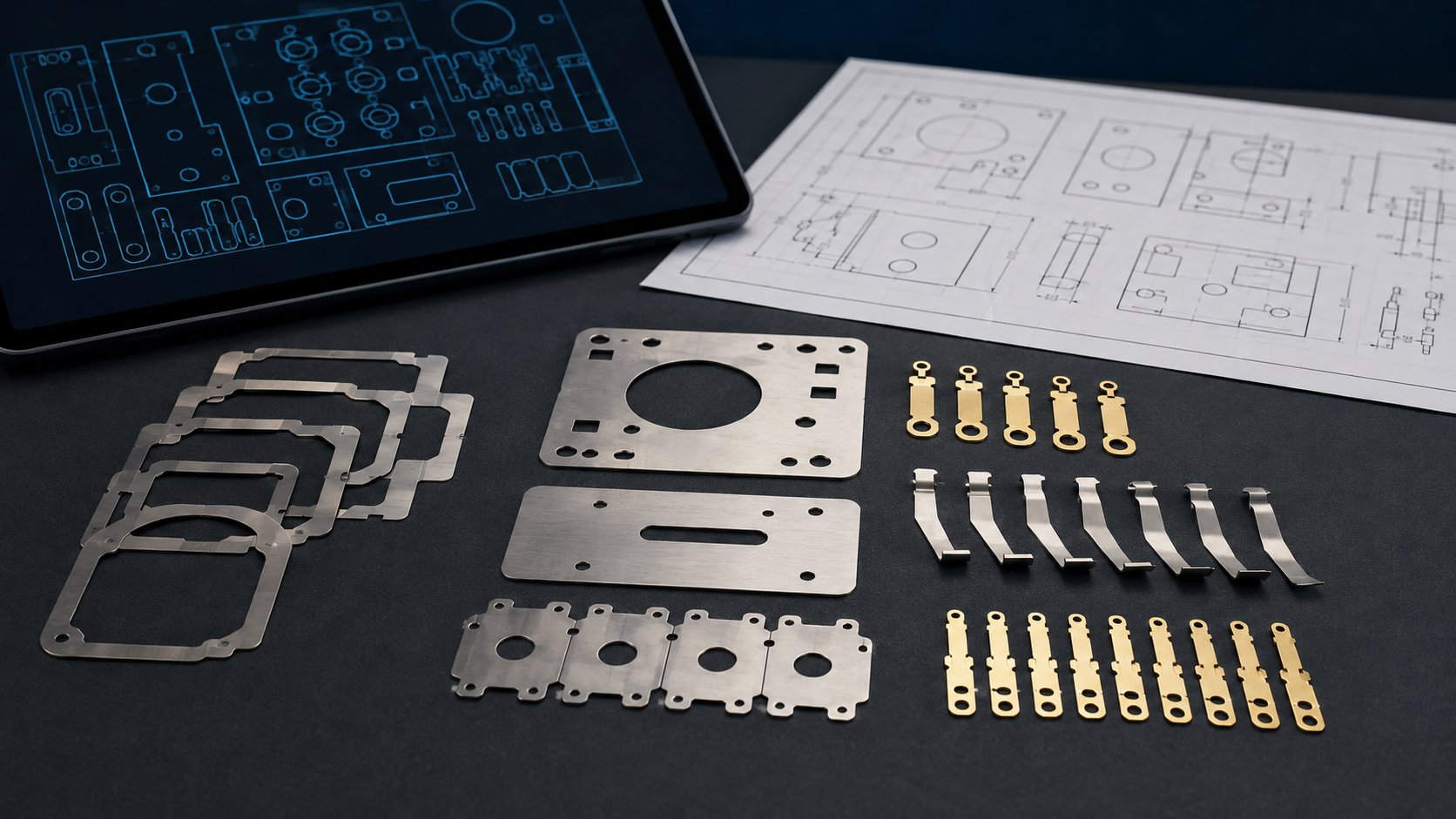
The process is particularly useful for thin, flat metal parts containing features such as:
- Small holes.
- Narrow slots.
- Fine grids.
- Apertures.
- Tabs.
- Complex external profiles.
Because the geometry is defined through digital phototooling, many design changes can be made by updating the pattern rather than creating a new hard stamping die.
Prototype Parts That Can Be Chemically Etched
Hardware startups may need many different small metal components during product development.
One common example is a shim or spacer.
A metal shim can help control gaps, mounting height, alignment, or assembly spacing between components.
A prototype shim may need:
- A custom outer profile.
- Internal openings.
- Mounting holes.
- Slots.
- Alignment features.
If testing shows that the spacing needs to change, the team may revise the geometry or select a different material thickness before the next build.
Other parts that may suit chemical etching include electrical contacts, flat springs, sensor apertures, shielding blanks, and thin precision plates.
Why Digital Phototooling Helps Startups
The value of digital tooling becomes clearer when a design goes through several versions.
A typical development loop may look like this:
Prototype V1 → Test → Update CAD → Revise Pattern → Prototype V2
This is useful because early hardware rarely works perfectly on the first attempt.
A team may change:
- Hole diameter.
- Slot position.
- Contact shape.
- Mounting geometry.
- Open area.
- Outer dimensions.
With chemical etching, these changes are made in the artwork used to create the pattern.
That does not mean design changes are free. Engineering, setup, material, inspection, and production still have costs.
The advantage is that the team is less dependent on a dedicated mechanical cutting die while the geometry is still changing.
Rapid Prototyping Is About Learning
A prototype should answer a question.
- Does the component fit?
- Does the sensor receive enough airflow?
- Does the contact align with the PCB?
- Does the spacer create the correct gap?
- Does the assembly survive repeated use?
Startups should therefore avoid treating the first manufactured part as a miniature version of final mass production.
The first objective is learning.
A good prototype process makes it possible to discover mistakes early, update the design, and test again before those mistakes are multiplied across thousands of units.
From Prototype to Pilot Production
Hardware development normally moves through several stages:
Concept → Functional Prototype → Engineering Validation → Pilot Run → Production
Manufacturing requirements change at each stage.
A functional prototype proves that the basic idea works. Engineering validation checks whether the design performs under realistic conditions.
Pilot production tests whether the manufacturing and assembly process can produce repeatable results.
Only after these questions are answered should a startup make major decisions about high-volume tooling, inventory, and supply-chain commitments.
Chemical etching can support prototypes and selected repeat-production programs when the part geometry remains suitable for the process.
Fine Screens for Prototype Electronics
Many hardware products also require controlled openings for airflow, sensing, sound, or physical protection.
Custom metal screens can contain repeated holes or other aperture patterns together with their outer mounting geometry.
They may be useful in prototype electronics such as:
- Sensor modules.
- Environmental monitors.
- Compact electronic enclosures.
- Airflow openings.
- Protective covers.
During development, engineers may need to change hole size, open area, shape, or mounting features after testing the complete device.
Digital patterning makes these types of revisions easier to evaluate before committing to a mature production design.
When Chemical Etching Is Not the Right Choice
Startups should not choose chemical etching simply because the design is still changing.
Different components need different processes.
A thick three-dimensional metal housing may be better suited to CNC machining. A plastic enclosure may use 3D printing during prototyping and injection molding later.
Large sheet-metal profiles may be laser cut. Simple components produced in very high volumes may eventually favor stamping.
Chemical etching is most relevant when the design combines thin metal, complex flat geometry, fine features, or repeated patterns.
Material, thickness, tolerance, volume, secondary processing, and total cost should always be reviewed together.
Reduce the Cost of Being Wrong Early
The biggest risk in early hardware development is often not the cost of one prototype.
It is committing too early to a design that has not been fully tested.
Flexible manufacturing gives startups more room to learn before making larger tooling and inventory investments.
For suitable thin metal components, chemical etching can support this approach by allowing detailed patterns to be produced from digital artwork without relying on a dedicated hard cutting die.
That can help hardware teams move through prototype, validation, and pilot stages while keeping one of the most important startup advantages intact: the ability to change the product when testing shows that the original design was wrong.