
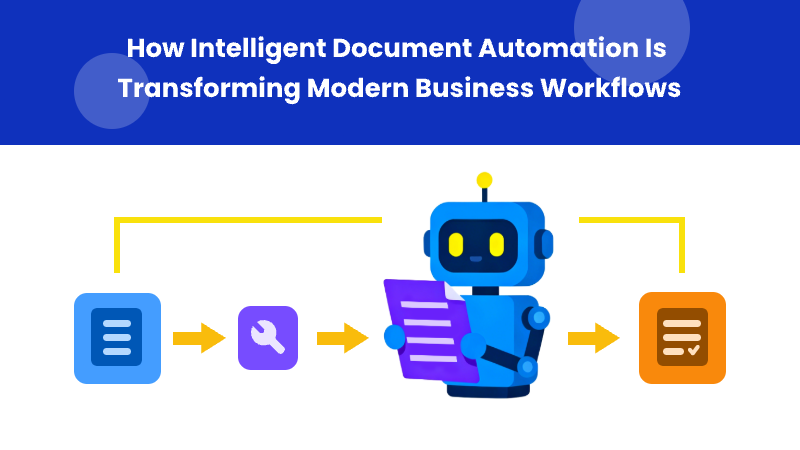
In the modern corporate landscape, data is often called the new oil, yet much of it remains trapped in “storage tanks” that are difficult to access: PDF documents. While enterprises have digitized their files, many have failed to digitize their processes, creating a productivity gap that widens as they scale.
Manual data entry and document sorting are becoming operational bottlenecks. To bridge this gap, companies and organizations are turning to Intelligent Document Automation, a transformative approach that converts static documents into dynamic, automated workflows.
What Is Intelligent Document Automation?
To stay competitive, organizations are moving beyond simple digitization to Intelligent Document Automation (IDA). This isn’t just about uploading paper files to a cloud folder or using basic optical character recognition (OCR); it’s about creating a system that understands, processes, and generates content automatically with less human intervention.
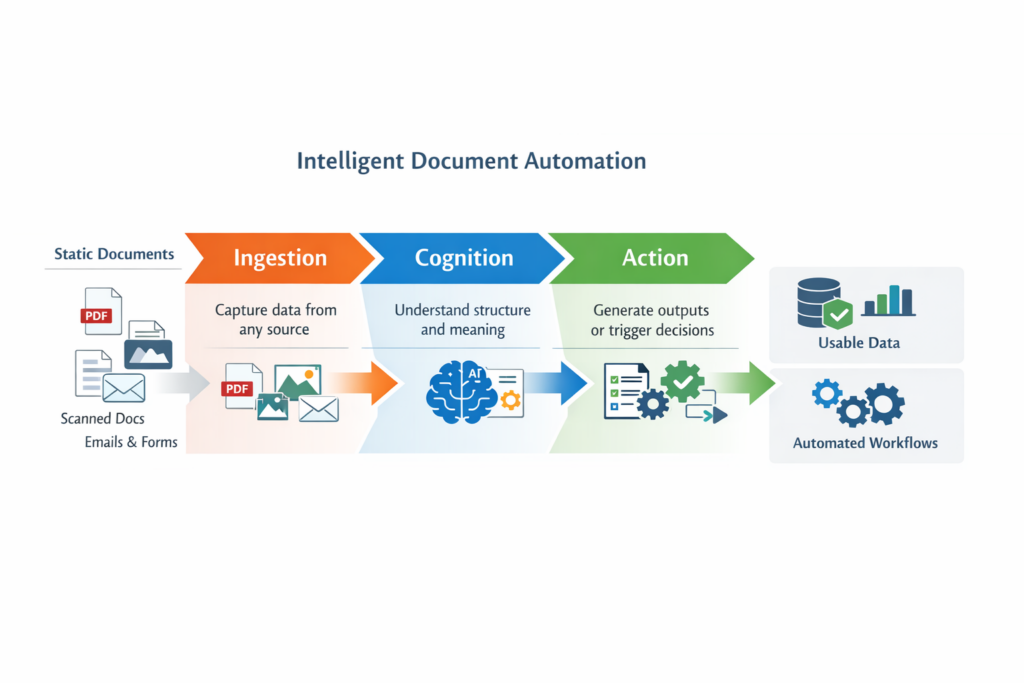
The fundamental difference between traditional automation and IDA is the “intelligence.” Traditional tools simply follow rigid rules—if a document doesn’t fit a specific template, the process breaks. IDA, however, is designed to be more flexible. It views the document lifecycle as a dynamic flow:
- Ingestion: Capturing data regardless of the source.
- Cognition: Understanding the context of the information.
- Action: Generating new outputs or triggering business decisions.
This improvement allows companies to treat documents as usable data rather than static files.
The Hidden Cost of “Manual-First” Workflows
Before looking at solutions, it’s important to understand the hidden costs of manual document handling. When an employee spends two hours a day copying and pasting data from vendor invoices into an ERP system, the cost isn’t just their hourly wage. The real cost includes the probability of data entry errors, the delay in vendor payments, and the “opportunity cost” of that employee not performing high-value analytical work.
Furthermore, manual workflows create information silos. When data is locked inside a PDF on a specific hard drive, the rest of the organization remains blind to that information. This lack of transparency leads to redundant work and slow response times, which can be fatal in fast-moving industries like fintech or supply chain management.
Turning Static PDFs into Actionable Data
For years, the PDF was considered the “final” format because it is great for viewing and printing but difficult to manipulate. Business intelligence often gets slow or stuck because critical data are locked inside thousands of legacy files or complex research papers.
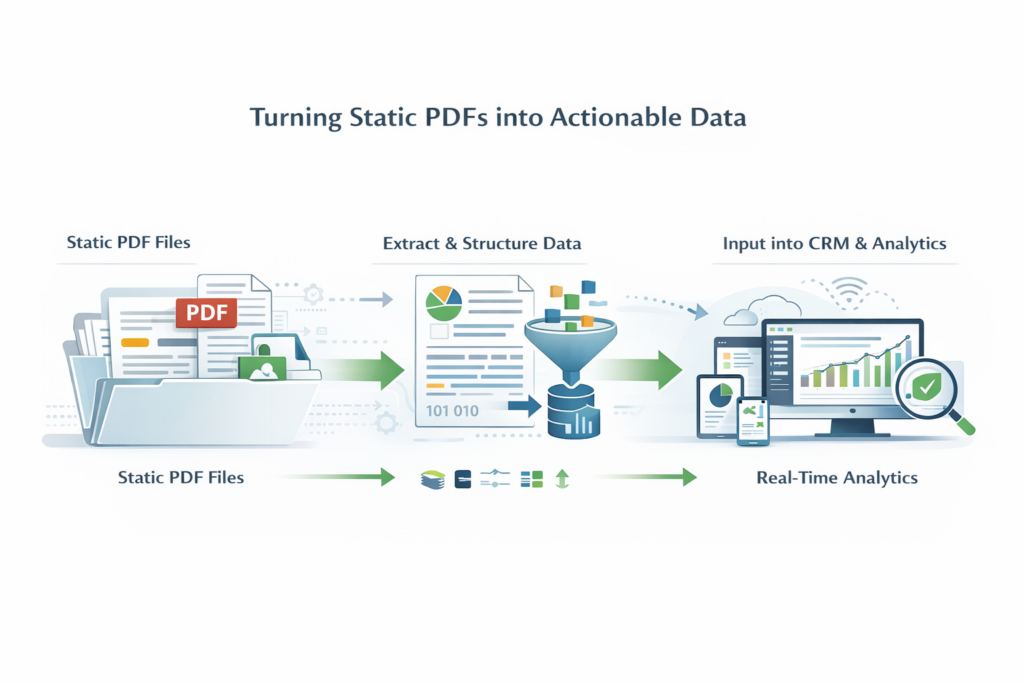
The first step of document automation is to extract text from a PDF document automatically. By turning these static files into structured, machine-readable data, companies can input information directly into their CRM or analytics tools. This transition reduces the hours spent on manual review and ensures that decision-makers are working with real-time insights rather than old manual tallies from weeks ago. It transforms the PDF from a digital dead-end into a gateway for business intelligence.
From Data to Documents: Automating Creation at Scale
Once a business has mastered the art of retrieving data out of PDF documents, the next challenge is putting it back in. As a company grows, the demand for standardized outputs, such as monthly performance reports, compliance certificates, or personalized customer agreements, rises rapidly. At this moment, the traditional “Save As” method of document creation is not enough.
This is where automated PDF document generation becomes vitally important. Instead of an employee manually typing data into a template, the system pulls updated records from a database and generates a professional document in seconds. This ensures total accuracy across thousands of files, eliminating the risk of human error and ensuring that every client receives a document that meets the same corporate standards.
Building End-to-End Document Workflows: A Case Study in Efficiency
The real advantage is that these tools are not used in isolation. Together, they boost the entire workflow. Let’s look at a typical “Closing the Loop” workflow in a modern legal or finance department:
- Phase 1 (Extraction): An incoming contract is received via email. The system automatically extracts key dates, parties, and financial obligations.
- Phase 2 (Processing): The extracted data is compared against internal compliance rules. If a discrepancy is found, an alert is triggered.
- Phase 3 (Generation): Once approved, the system automatically generates a summary “Execution Memo” and a set of onboarding documents for the new client, ready for signature.
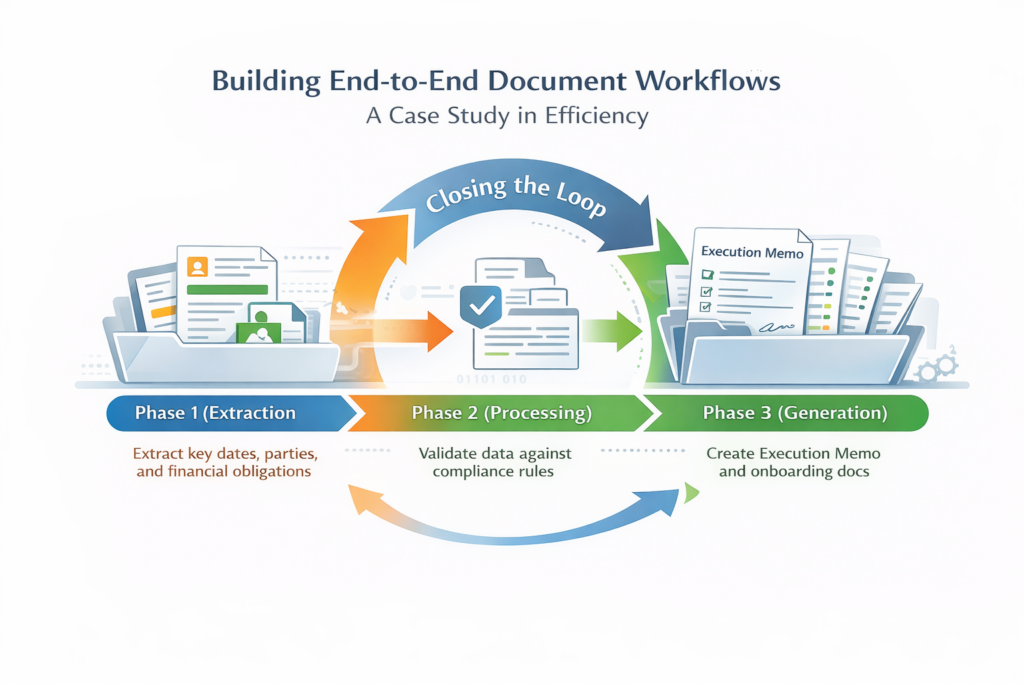
This end-to-end approach creates a seamless environment. By connecting the extraction with the generation, businesses can significantly shorten the operational cycle. The old process with back-and-forth emails and manual drafting can now be accomplished in minutes, allowing teams to focus on strategy and relationship-building rather than formatting and filing documents.
Who Benefits Most?
Many organizations can improve operational efficiency through intelligent document automation, but the impact is most significant for the following industries and sectors.
- Scaling Startups: Where lean teams must handle enterprise-level paperwork without hiring an army of administrators.
- Finance & Operations: Where accuracy in reporting is non-negotiable and regulatory audits require instant access to structured data.
- Legal & HR Departments: Where the volume of contracts and employee records can easily overwhelm manual filing systems.
- Data-Driven Organizations: Any firm that regards information as its primary competitive advantage.
For these groups, the shift isn’t about becoming a tech company. It’s about upgrading their internal engine with IDA to support exponential growth.
Conclusion
Documents should be the fuel for your business, not the brakes. By integrating intelligent automation into systems, organizations shift the role of the document from a static burden to a dynamic strategic asset. The era of manual workflows is giving way to systems that are faster, more accurate, and infinitely more scalable.
The ability to process information at scale will divide the market leaders from those left behind. Companies that embrace document automation will not only save time but will also build a more resilient and agile foundation for future challenges.